September 1, 2010, 7:38 am

Here’s some white Exaddata text
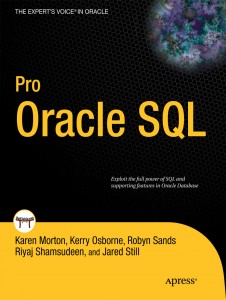
Well, I guess it’s official. A couple of weeks ago I committed to write an Exadata book for Apress, along with my intrepid co-author Randy Johnson. For those of you who don’t know Randy, he’s a very experienced Oracle Guy with a wealth of knowledge, particularly around RAC. I think the two of us make a pretty good team – making up for each others weaknesses (oh wait, I should say we have “Complimentary Skill Sets” – yeah that sounds better).
Anyway, it turns out that writing a book is a lot of work! The way Tom Kyte turns them out I thought it must be pretty easy, but I’ve always been a little overconfident. So I’m starting to realize that I may not have time to do as many blog posts as I might like. But I must say that I am really excited about the subject matter! So I think it will be worth the effort. By the way, that’s not the official cover art (or even the official title as far as I know). I just hacked that together with a Adobe Illustrator. ;-)
As I have said many times, I think the Exadata storage software will usher in a whole new era in relational databases. Not just for Oracle, because you know the other guys will be trying to follow in their footsteps. But I think Oracle is miles ahead at this point, and they own their own hardware platform. Oracle claims that it has been their most successful product launch ever and I believe it. They are starting to pop up like weeds. It will be very interesting to see what the future holds for this platform. To be honest, I think we’re just seeing the tip of the iceberg at this point. Anyway, I appreciate the guys at Apress having the faith in us to take on this project. I hope we don’t disappoint them (I don’t think we will).
August 28, 2010, 12:10 pm

I am very proud to be one of the newest OakTable Network members!
(That My Happy Face)

August 26, 2010, 5:44 pm
Randy Johnson has done a brief post after applying BP5 on our Exadata Lab machine. Looks like it went pretty smoothly with the exception of a problem with DBFS and some misleading comments in the README file regarding using the RDS protocol (both of which we had in play). Here’s a link to his post:
Exadata Bundle Patch 5 Gotcha’s
August 24, 2010, 9:52 pm
Well we had to give it a shot.
So we created an Oracle Exadata Storage Server Software CELLBOOT USB flash drive. I’m not kidding, that’s what the Oracle/Sun guys decided to call it. They didn’t even use an acronym in the manual (I guess “ESSSCB USB FD” doesn’t roll off the tongue much better than the whole thing anyway). We used the make_cellboot_usb utility to create the thing off one of our storage servers, which by the way was not that easy to do, since the USB ports are in the back of the 4275’s and they are not easy to get to with all the cabling that’s back there. Anyway, once we had the little bugger created we pulled it out of the back of the rack and booted a Dell Latitude D630 off of it. Here’s a picture:

Notice the thumb drive is all lit up like a Christmas tree.
Here is a close up of the screen (in case your eyes are going bad like mine):

So we tried a couple of different options but eventually got to this screen:

Notice the ERROR line in the middle of the screen. Somebody wisely put a check in the boot procedure to verify the machine type, presumably if it’s not a Sun 4170 it will throw an error. We thought about hacking the system but decided not to at this point as we had real work to do. (maybe later when we’ve got nothing else to do)
August 10, 2010, 1:09 pm
Wow! – I was stunned a few days ago by Exadata’s Storage Indexes. I was doing a little testing to see what could be offloaded and what couldn’t (more on that later). I have a 384 million row table I was using on our Exadata Quarter Rack test system. A single threaded full scan with no where clause on the table takes about 24 seconds (ho hum – it’s amazing how quickly we become numbed to the outstanding performance ). So imagine my surprise when I decided to check and see how many nulls I had in a column and the result came back in .07 seconds. Wow! I thought it was a bug! Turns out it was the Storage Indexes. Alright already, I’ll show you some output from the system (by the way, as usual I used a couple of scripts: fsx.sql and mystats.sql):
SYS@LABRAT1> select count(*) from kso.skew3;

  COUNT(*)
----------
 384000048

1 row selected.

Elapsed: 00:00:24.06
SYS@LABRAT1> /

  COUNT(*)
----------
 384000048

1 row selected.

Elapsed: 00:00:23.94

SYS@LABRAT1> set timing off
SYS@LABRAT1> @mystats
Enter value for name: %storage%

NAME                                                                             VALUE
---------------------------------------------------------------------- ---------------
cell physical IO bytes saved by storage index                                        0

1 row selected.

SYS@LABRAT1> set timing on
SYS@LABRAT1> select count(*) from kso.skew3 where col1 is null;

  COUNT(*)
----------
        12

1 row selected.

Elapsed: 00:00:00.07
SYS@LABRAT1> set timing off
SYS@LABRAT1> @fsx
Enter value for sql_text: select count(*) from kso.skew3 where col1 is null
Enter value for sql_id:
Enter value for inst_id:


 INST SQL_ID         CHILD  PLAN_HASH      EXECS     AVG_ETIME      AVG_LIO    AVG_PIO AVG_PX OFFLOADABLE IO_SAVED_% SQL_TEXT
----- ------------- ------ ---------- ---------- ------------- ------------ ---------- ------ ----------- ---------- ----------------------------------------
    1 0u1q4b7puqz6g      0 2684249835          5           .09    1,956,226  1,956,219      0 Yes             100.00 select count(*) from kso.skew3 where col

1 row selected.

SYS@LABRAT1> @mystats
Enter value for name: %storage%

NAME                                                                             VALUE
---------------------------------------------------------------------- ---------------
cell physical IO bytes saved by storage index                              16012763136

1 row selected.
So apparently Storage Indexes are NULL aware. Very cool! This may have repercussions regarding design and implementation decisions. There are systems that don’t use NULLs in order to insure that they can access records via B-Tree indexes (which as you’re aware do not store NULLs). SAP for example uses a single space character instead of NULLs.
Continue reading ‘Oracle Exadata – Storage Indexes’ »